


Amlwch to Moelfre (Anglesey's Wild North Coast Part 2)
Updated: May 31
Walk: From Amlwch to Moelfre following the coastal path around the North East Tip of Anglesey
Distance: About 14 miles - quite a day out, but with a pub/refreshment-stop just when you need it
Parking: The free car park in Moelfre - right opposite the bus stop and with free public loos (in summer at least)
Bus Route: Arriva Wales Bus Route 62 from Bangor to Amlwch.
This route, and the preceding leg (Cemaes Bay to Amlwch, BusPassNBoots blogged in 2023, but actually done the other way around), are stunners.

There are many parts of the Wales Coast Path that stir the heart, but these two have a certain brightness of colour and ruggedness that puts them, in my book, right up there.
I think Rosie would appreciate more close-contact to swamps and the sea but she can't drive and doesn't have her own bus-pass, so it's my opinion that holds sway here. For colour, the walk is best done when the sun is out. But, for colour, that's the same everywhere.

The walk starts in the maritime village of Moelfre, home to a big lifeboat and some epic historic rescues. It is also home to a free car park with good clean free public toilets. Note: Though open in September 2024 when I did this walk, I was last there at the end of October and the toilets were locked up. Could have been just a temporary closure I guess, as I am pretty sure most humans don't lose the need for a pee as the weather turns colder - quite the opposite.
The bus stop at Moelfre is opposite the car park. It is the same stop independent of whether the bus is heading North (to Amlwch) or South (to Bangor) so it’s a good idea to make sure you are getting on the right one. The coast path from Bangor back to Moelfre would be a proper mission!
The bus trip to Amlwch is about 15 minutes. The best place to get off in Amlwch is near the Co-Op which is opposite the recreation ground. From there it is good 15-20 minute plod through town to eventually pick up the coast path at the eastern end of the old Port.

If you don't have a mapping app on your phone to guide you, the route through town I took was to cross the recreation ground, turning left at the chain-link fenced area to come out on Wesley Road, turn right up Wesley Street for a hundred meters and then right again onto Parys Road. Keep straight on toward town (Parys Road becomes Machine Street). Go downhill into town (see photo) passing the undertakers on your left eventually turning left into Quay Street opposite the Liverpool Arms. You can go down and walk along the historic Quay where, back in the day, up to 100 tall-ships a day would queue to take away the copper ore mined from Parys Mountain (just a few miles south), coming up again before the pier and the Lighthouse jetty. This trip, realising it is a long walk ahead, I stayed high turning onto Upper Quay street, leaving the port behind and accessing the Coastal Path at the end of the car park at the end of that road. The coast path leads east behind the walled garden of the boarded-up property ahead.

Going behind the property, a red squirrel came darting along the wall, so close I could have reached out and touched it ..., if I hadn't been fumbling trying to get my phone out of my pocket to get a photo that is. I hate that I was so keen to get a photo, I actually missed the enjoyment of the close encounter with this iconic beastie. The photo I got is here. Yes, I know, its pants. That brownish red thing that looks like an Irish bloke's toupee fleeing west is the squirrel. It had probably been juggling a couple of acorns and doing a complete river dance right in front of me before I was able to get my phone out and press the button! Evidence of the stupidity of not savouring the certainty of the moment for the possibility of bragging rights of a nice pic. In my defense this time, red squirrels are ridiculously quick.

After giving myself a good kicking, it was time to get on with the walk as the industrial architecture of the port gives way to the rugged coastline running eastward to the Trwyn Eilian (aka Point Lynas) Lighthouse in the distance. This part of the coast is really good for spotting dolphin's and even, if you are very lucky, whales but it was disappointingly sea-mammal free on the particular day (in September 2024) that Rosie and I did it. Tip: one of the best portents of being able to spot dolphins are gannets circling and diving to the sea in a particular spot offshore. They share a fondness for mackerel. That is what the gannets are after and, if there is a decent shoal, its also likely that the dolphins are there too (or if not, on their way). If you see the gannets diving, spend a moment and point some decent optics their way (is my advice).

About a mile out of Amlwch the path drops down some steps with a wooden bridge crossing a pretty stream that spills into the sea across some rocks. Just over the bridge, keep an eye out for Ffynnon Eilian (Eilian's Spring or Well)) up to the right. It was Rosie that alerted me to this. From where I was looking from, it was as though she was sniffing the bald head of some small bloke sitting in a dip. Turned out she was!
Digression alert: After a holy start, there is evidence that this well (now dried up a tad), became used as a 'cursing well'. An excavation on this site in 1925 turned up a slate with a wax effigy which had an arm missing and some initials carved into the slate onto which it was fixed. The well's more famous namesake, in Colwyn Bay on the mainland, was well known in the 1800s as a reasonable place to go to to put a curse on people whom you wished ill of. This area of Anglesey also had other evidence of similar uses. I read that an excavation at a 'holy well' site closer to Holyhead revealed a mug within which was the remains of a frog that, gruesomely, had had various pins stuck in it. The mug was covered by a slate on which 'Nanny Roberts' was written. I think I'd rather not know what Nanny Roberts had done to deserve such venom or indeed what had became of her (or, for that matter, what became of the person cursed by the effigy found at this site on our walk). Much more comfortable with the idea that such things were fiction, though evidently they weren't.
Another digression alert: On a lighter note, on the walk, happily oblivious of the cursing well evidence at the time, I chuckled to myself thinking that if I had met a tonsured St Eilian here 1600 years ago I might have been tempted to alert him to the fact I'd witnessed his toupee making haste along a wall toward Amlwch 25 minutes earlier....

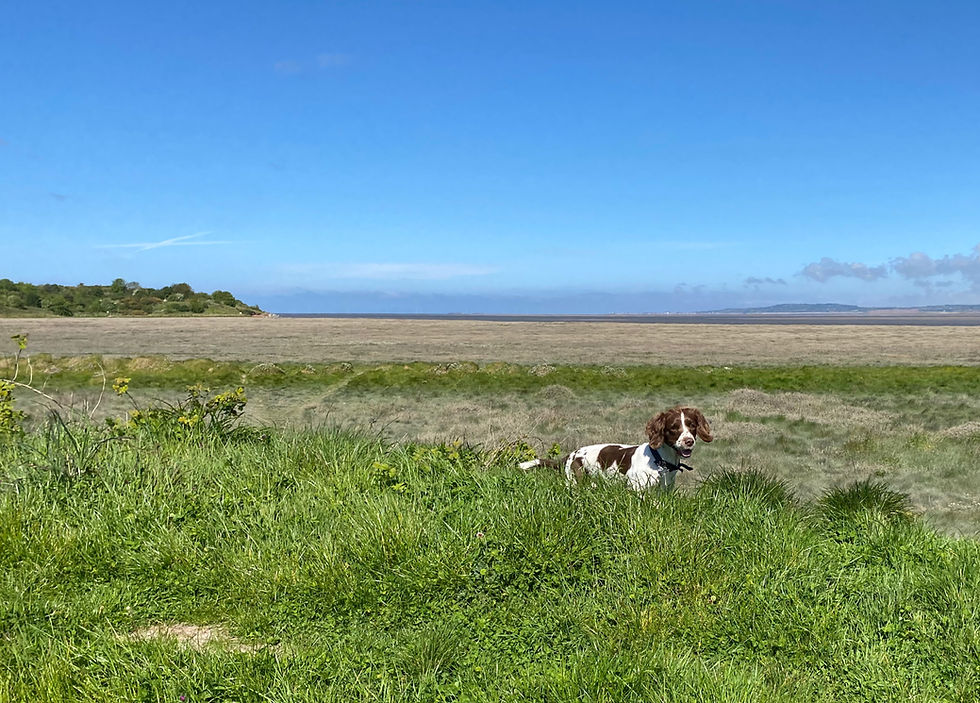
After the well, continue east across the heathland and fields, with one eye looking out to sea for diving gannets, toward the Trwyn Eilian (Point Lynas) headland. Eventually you drop down to the small, quite-seaweedy beach at Port Eilian, with its opportunity (taken, in this case) for Mrs Furry Pants to have a swim (see photo at the head of this post). Continue the walk by skirting the edge of the car park above the beach to reach the track that leads to the lighthouse. It is easy to miss the coast path sign that diverts east then south just as the track turns full north for the lighthouse so keep your eyes peeled. On a different (shorter) walk, the lighthouse (actually built by the Mersey Docks and Harbour Board) is well worth a visit, if not for the maritime architecture (it maintains a light out to sea is also now a lightl rather cool holiday accommodation) but for its fantastic position on this little blue planet. A brilliant place to hunker down with a flask and a sandwich and some binoculars to watch the world passing by at a near glacial pace and possibly get a glimpse of the rare Rissos dolphins that regularly appear off the point (in late summer at least).

Once you turn south, the scenery changes. The sea is a little less wild (but no less dangerous given the long list of shipwrecks along this east coast of Anglesey). Make your way through ferns and pasture away from the lighthouse. After about a kilometre, the path forks. The coast path sign guides you on what looks like (and is), the less direct, seaward, route. Take it! Although it is a slight dog-leg to reach the target gate through the fence slightly inland, ahead and uphill of you, it takes in a delightful viewing point ideal for a stop and a bit of early lunch. (see photo).

After fuelling up and soaking in some scenery, head back inland a little to pick up the gate you could see from the fork. Continue on the clear footpath through the scrubby bushes and pasture, looking back over your shoulder occasionally to enjoy the view back toward Trwyn Eilian from this elevated position. When directed by the coast path signs, head back toward the sea through a little arch of trees Keep on the path which then bears right (south) heading parallel to the coast. Slightly inland in this section you can see a WW2 look-out post, too far off the path to divert to. It's would have been a harrowing place to be stationed during the bombing of Liverpool. Surreally far away from the horror, but not far enough that it wouldn't feel real.
There was a big dark-coloured raptor that kept appearing in front of us on this stretch. It had the habits of a harrier, flying low over the ferns and occasionally going to ground. Like the squirrel incident though, I wasn't quick enough to get the binoculars on him or her to identify. Probably just a buzzard but not one you'd want to fight.

The obvious next landmark feature is the small rocky outcrop with a small tower on top, off the coast to the south (Ynys Dulas). The tower apparently served two purposes, first and foremost to sign-post the rocky outcrop on which it stands but also to act as a temporary refuse for any sailors who found themselves de-shipped in this neck of the woods; a seemingly regular occurrence in the madness of the age of sail.
It's still some way south before you draw level with the island. There is evidence of renovation work on this section of the path. A new bridge and some steps help you across what must have been quite a muddy patch. When almost opposite Ynys Dulas, the path crosses a small stream and then enters a field, following two edges, the latter being directly away from the sea and the Island with the tower on. Its tempting to cut directly across but I'm not totally comfortable with cattle, and there were cattle here. They watched us but stayed put. I still felt more comfortable sticking to the path. At the top of the first field, when the trees to your left cut out, carry straight on, still continuing away from the sea, to a stile accessing the corner of a lane.

Don't turn left on the lane, carry straight on away from the field )see photo). In a little while, you’ll pass the entrance to the Llys Dulas Estate on the left, and various other properties on the right (one of which is called Mill Pool Cottage I recall). What feels like just a little bit too far along this lane (just short of a kilometre after you joined it), the road climbs out of a dip first bearing right then left with a collection of farm buildings down to the left. Just after the road bears left, about 50m or so from the driveway to a property called Plas Uchaf (on the right), the coast path cuts off left. Follow the way the sign points across a field to find a gate in the bottom left hand corner (with some difficulty as it is surrounded by bushes). Go through the gate and turn left onto the dead-end lane which, about a mile later, leads out onto the Traeth Dulas estuary.

This is the estuary with the much photographed visible shipwreck to the left. The tide was in when we were there so the estuary looked just like a big inland lake. The coast path turns inland (right), away from the coast, on what is quite a boggy path. Happy dog! Near the head of the estuary is a small bridge with a parking area just beyond it (see photo). Continue on past the parking area, making your way along the lane, until the coast path sign guides you left. In the distance you can just see a pedestrian bridge crossing the small river/ stream (Afon Goch) that feeds into the estuary. Make your way to it, looking out for curlew and other exotic estuarine beasties. Cross the bridge and continue directly ahead through a gate and uphill. Bear slightly left through a gate that gives access to another gate and a track that leads right, up toward the main road. Turn left at the main road and immediately left again into the carpark of the Pilot Boat Inn. By this point you have come what feels like a shocking way inland and still have a long way to go when you get back to the coast. The pub sells beer (surprise surprise) and is dog friendly. I think both of us were a tad mal-odorous, so we got an ice-cold beer (for me) and a lovely big bowl of cold water (for the swamp hound) and sat outside to refill the bilges without unduly disturbing those inside enjoying the pub fayre.
Digression alert: The pub is near a bus stop and provides an alternative parking/ starting point for a shorter walk. If we'd have done that, we'd definitely have taken the detour around the port at Amwlch and spent some time up at the lighthouse at Point Lynas.

As it was, we still had a fair few miles to cover before getting back to the car so off we headed. The coast path takes you uphill behind the pub, through meadows. There is a small lake at the top. It took little encouragement for Rosie to shed the last remnants of swamp juice here. Always a bonus when heading back toward the car (though there are plenty of opportunities on the several beaches between here and the car too). Once over the top you get eyes-on to Ynys Dulas again, looking dishearteningly about the same as it did when you turned your back on it several hours earlier. The path leads downhill to the accessible, and relatively unpopulated, beach at the south end of Traeth Dulas estuary where the path turns due south to mark the last leg of the walk.

The next milestone is the popular beach at Traeth Lligwy with its car park, toilets and ice cream availability. Very different to the remote feeling of the north coast. It would appear even more pretty if the bar hadn't been set ridiculously high by the stunning unpopulated coastline to the north. At least here, access to the very swimmable-inable sea is easy. The photo here was taken on a glorious day from a previous trip in August 2022. Though there were plenty of people, it didn't feel crowded.
Follow the coast path signs that guide over the cliffs at the south end of the beach. After some beachside properties overlooking a small private beach the coast path becomes rugged again for a short section until, eventually, the settlement of Moelfre comes full into view.

It is still a mile back to the car park, further if you opt to take in the headland opposite Ynys Moelfre and the lifeboat station. Eventually though, which ever route you choose, you'll end up back at the beginning of the adventure, satisfied after completing a spectacularly varied section of the Wales Coast Path and, if you are like me, gagging for a well-earned treat of Fish and Chips with a cold can of your choice. Not difficult to find, either just around the corner from the car park on your way out of Moelfre or, if that doesn't suit, in Benllech (and multiple other places) on your way off the island and back to whatever reality it is you call home.


Comments